There is a proposal afoot in New Jersey to merge Rowan University and Rutgers University's Camden campus and to rename the merged institution as entirely Rowan University.
I think this is a terrible idea and would love to discuss my reasons with anyone willing to listen. The following is a list of talking points with which I wholeheartedly agree.
1. The plan robs South Jersey of the benefits of a university with a world-class reputation. South Jersey residents have been paying taxes and tuition for centuries to build Rutgers into a world-renowned university. If this plan goes into effect, South Jersey residents will instantaneously lose all of their accrued principal in The State University of New Jersey. That is fundamentally unfair.
2. It will take decades or centuries for an unknown regional university to attain anything like the status of Rutgers. This is one more example of South Jersey being treated as a second-class region of the state. Central and North Jersey will continue to be served by world-class Rutgers, and South Jersey has to settle for an institution unknown beyond South Jersey.
3. Rutgers–Camden has top-flight faculty because we are Rutgers. We can recruit people at the very top of the field, who bring their expertise to the South Jersey region. Jacob Soll’s Macarthur is a recent example. Rowan cannot do that and will not be able to the same for the foreseeable future.
4. Economically successful regions are driven by the presence of several strong diverse institutions of higher education. The Bay Area in California draws from the research outputs of Stanford, multiple campuses of the UC system, multiple campuses of the Cal State system, and many private universities. The Research Triangle is driven by three research universities. Boston and its 128 corridor are driven by the presence of innumerable colleges and universities. Yes, helping Rowan grow and improve will bring benefits to the region. But South Jersey needs more higher education activity, not less. Folding a campus of a great research university into a minor regional university is a net loss for the region.
5. The commission began with a charge to study medical education, and they never really got past that frame. The whole analysis is driven by the fact that Rowan is connected to the Cooper Medical School. The Cooper Medical School is not even offering classes yet, so the significance of that relationship is far less than the significance of the relationships of all of the Rutgers-Camden programs to Rutgers. If we are to reorganize higher education so drastically, it should be driven by a study that looks holistically at higher education, not as an afterthought to an analysis of medical education—which is important, but isn’t the only important issue.
6. The commission was studying higher ed and medical education. It contained two lawyers, no physicians, and just one former higher education official. These are honorable and respected citizens, but we should not make such a drastic change without having the right mix of knowledge and experience in the room. We need proposals based on the right mix of expertise, and we need careful deliberation that includes the residents of New Jersey and our elected representatives.
7. The recommended path represents the worst kind of government over-reach—just the sort of thing Chris Christie has built his reputation opposing. Rutgers and Rowan have been growing successfully despite dwindling state support and a bad economy. Rutgers continues to cement its strength as a world-class university, and Rowan has become a successful regional university. The recommended reorganization puts all of that at risk because five people behind closed doors think it’s a good idea.
8. Rutgers-Camden is helping make the right kind of revitalization happen in Camden—the slow, steady growth of jobs and an increase in education levels in the city. Folding Rutgers-Camden into Rowan will shift the focus away from the necessary revitalization of South Jersey’s urban center.
Thank you.
--End--
Showing posts with label school. Show all posts
Showing posts with label school. Show all posts
1.31.2012

11.01.2011
Romantic Scenery
Not the greatest paper I've ever written (mostly because I neglected to note one of the objectives of the assignment ... oops!), but here's a sample of my recent scholarly work.
Contact me for Works Cited.
Copyright 2011.
Embracing Visual Realism and Technological Advancement:
Romantic Scenery and Stage Design
In the second half of the 18th Century, theatre design became increasingly reliant on the visual over the literary. In contrast to the bare stages of Elizabethan theatre or suggested scenery of the Restoration drama, Romantic drama became a “theatre of illusion” (Carlson 492). During this time period, not only the “off Broadway” style of theatre depended on larger-than-life spectacle. Even the legitimate patent theatres relied on attracting and keeping audiences by means of set design and special effects.
As entertainment options mushroomed throughout 18th Century London, as well as throughout Europe’s other great cities, theatre-goers became ever more immune to the charms of minimalist theatrical interpretations. Once Garrick began employing natural and emotional intonation and inflection in his interpretations of classic and new plays, the audience was immediately involved at a more intimate and emotional level. And, once theatre managers saw the audience’s deeper involvement in each play, they saw the opportunity for future theatrical successes. Eventually, this led toward the spectacular trend. Each show built on the effects, scenery, emotional pull, effects, etc of the prior one. Although he intended it sarcastically, even Wordsworth could hardly help but notice how spectacular shows “fitted the taste of the audience like a glove” (qtd. in Glance). In addition, as theatrical auditoriums and stage spaces grew in size, it became more and more important to present grand and spectacular productions. “The size of the stage and its distance from spectators require that they are given more, larger and more spectacular things to see” (Carlson 497).
Furthermore, playwrights began to notice that increasingly complicated visual effects could lead to critical and financial success for their shows. Stage directions within manuscripts grew wordier, more complicated and more specific. Playwrights wanted nothing left to chance in the interpretation of their creative visions. In The Castle Spectre, Matthew Lewis gives the following stage direction:
The folding-doors close, and the oratory is seen illuminated. In its centre stands a tall female figure, her white and flowing garments spotted with blood; her veil is thrown back and discovers a pale and melancholy countenance; her eyes are lifted upwards, her arms extended toward heaven, and a large wound appears upon her bosum. (emphasis added) (IV:2)
But, just one year later – perhaps due to improved technology, perhaps due to the growing demands of an ever more jaded audience – George Colman the Younger insists upon the following climatic moment:
The door instantly sinks with a tremendous crash, and the Blue Chamber appears streaked with vivid streams of blood. The figures in the picture over the door change their position, and Abomelique is represented in the action of beheading the beauty he was before supplicating. The picture and devices of love change to subjects of horror and death. The interior apartment (which the sinking of the door discovers) exhibits various tombs in a sepulchral building, in the midst of which ghostly and supernatural forms are seen -- some in motion, some fixed. In the centre is a large skeleton seated on a tomb (with a dart in his hand), and over his head in characters of blood is written The Punishment Of Curiosity. (emphasis added) (II, 3)
The nature and quantity of special effects is increased monumentally. In the first example, there are closing doors, some dramatic lighting on an actress and then the sudden appearance of a wound on her “bosom.” However, in the latter, the stage crew must quickly lower a door through the stage, creating a “tremendous crash.” Meanwhile, the scenery and pictures in the room must all change appearance, streams of blood must pour down the walls, and within the inner chamber there are tombs, a giant skeleton, and moving and stationary ghosts. Later, the skeleton must stab an actor with the hand-held dart and drop through a trap door with its victim in tow. The demands on the scenic designers, set builders, and stage hands are great. And these demands grow greater with each new spectacular staging.
Scenery and special effects were as much a part of these performances as the actors, music or dialogue. Donahue notes, “For a century of more after play-going recommenced in 1660, the playbill remained mostly a listing of titles, actors’ names and roles, preceded by the name of the theatre” (10). Romantic period playbills, however, celebrated the elaborate landscapes, detailed set and thrilling effects as much as or even more than the performers themselves. Lists of the varied and exotic locales, heaped with superlatives filled patrons minds with the vivid imagery of what they might expect to see. Many of the posters and playbills would dedicate very little space to listing the actors in a given show, but instead would illustrate the various scenes and spectacles to expect during the performance. After all, if audiences are drawn to this sort of spectacle, it makes sense to advertise the visual delights of a production. Word of these spectacles would spread and fuel the public imagination. According to The Morning Post review the morning after the Blue-Beard opening, “The object of attraction was less than the merits of the romance itself, than the embellishments of which rumor had spoken” (334). Clearly, theatre gossip had paved the way for what thrills a patron might expect.
So, reviewers, too, came to expect a certain level of spectacle in the design and effects of a performance. Within the Broadview Anthology of Romantic Drama, numerous reviews comment on not only dialogue and acting, but also on the effectiveness (or not) of the scenery and mechanics of the performance. Emphasis was placed upon the successful execution of an elaborate trick, as well as upon the novelty of the effect or scenic display. Reviews of Harlequin and Humpo include such criticisms as, “there is a deficiency of rural scenery” and “the tricks are dull, and afford little that is new” (385). Whereas, Coleridge’s Remorse receives the following praise, “The … scenery, decorations &c. [contributed] to the success of the play…. The invocation scene was one of the most novel and picturesque we remember to have witnessed” (Cox 309-391).
Exotic spectacular melodramas such as Blue-Beard and Timour the Tartar receive particular praise, and it is interesting how frequently the reviewers seem to understand the effort on the part of stage personnel to achieve these complicated effects. Several reviewers extolled the scenic effects and elaborate constructions of the Blue-Beard production, but lament the difficulties with manipulating such complicated scenery and with managing the numerous special effects. The experienced eye apparently recognized that these difficulties would alleviate themselves with time and rehearsal. According to one reviewer, “The conduct of the whole betrayed a want of practice, which the necessary attentions of a repetition will remove” (Cox 331). Another review notes that “the gratification which the audience experienced from the exhibition … amply compensated for the inconvenience” (Cox 330). Where dramatic effect and spectacular exhibitions are concerned, it seems that the emotional and sensory end justified the laborious and ill-timed means.
Audience demand for spectacle and stimulation were not the only motivation and drive for theatre designers of the Romantic stage. The great landscape painter Philippe Jacques de Loutherbourgh saw great possibilities for artistic realism in the theatrical environment. Working with Garrick at Drury Lane, Loutherbourgh revolutionized the nature of scene painting and set design. “Loutherbourgh’s project was to present ‘realistic’ and pictoral images … that his audience would recognize and authentic and topologically accurate” (Baugh 309). The stage was no longer to be embellished in the audience member’s minds, but to be laid out in as richly detailed and accurate manner as possible.
This emphasis on realism was new. For the first time, sceneography had a purpose. Along with Garrick’s new emotional accurate method of performing both new and classic plays – through natural intonation and pacing, rather than rhetorical recitation – lush and detailed scenery allowed for “the birth of the stage picture as a coherent, harmoniously conceived whole” (Baugh 310). It was no longer acceptable for a contemporarily-dressed actor to plunk himself down in the middle of the audience, on a thrusting forestage, and deliver a sonorous, but monotonously intoned, soliloquy. Rather, with each far-too-frequent theatre fire and subsequent remodel, the forestage shortened and shortened until it disappeared altogether. By the end of this period, actors were all costumed as authentically and comprehensively as possible, framed in a gilded proscenium arch, posing and emoting, all the while surrounded by lavish, elaborately-designed and executed scenery – all part of a carefully researched and detailed visual spectacle.
As emphasis on scenic design grew, individual scenic artists developed their own specialties, and were known for their execution of particular techniques. Loutherbourgh was famous for his grand, sweeping landscapes, including waterfalls, mountains, seascapes, and crumbling rocks. Loutherbourgh’s counterpart, William Capon, was known for his “meticulously researched architectural scenes” (Baugh 314). Extensive historical and geographical research was put into ensuring as much accuracy as possible in every detail, whether interior or exterios spaces. Not only new plays, but also classics, including Shakespeare, were given this scenic treatment. At this time productions of Shakespeare are produced in “period” dress, taking place in an accurately portrayed Elizabeth England, a magical fairy glade, or even a Saxon interpretation of King Lear, complete with “Druid stone circles, round helmeted soldiers,” and so forth (Baugh 317).
Eventually this almost slavish attention to scenic detail would become almost an end unto itself. Designers would employ numerous scenic artists, builders, seamstresses and researchers in order to more fully develop plays, including Shakespeare’s, for the audience. The scenography of the plays rapidly established itself as the meaning and purpose and even text of the theatre, rather than the words of the play, itself. William Poel, founder of the Elizabethan Stage Society, mocked this inclination, saying artists must “accurately produce the colouring of the sky, of the foliage, of the evening shadows … of the men’s and women’s eyes; for all these details are important to the understanding of the play” (Qtd. in Baugh 321).
Naturally, some middle ground must be established in the dramatic world. Modern critics and theatre patrons would agree that great theatrical experiences cannot exist in the absence of a great text. To post-Romantic eyes, neither can great theatre exist in the absence of a complete and appropriate setting. Our modern theatrical experience relies heavily on the scenic advancements and other changes made throughout Romantic drama. Modern audiences, like their 18th Century counterparts, expect professional theatrical productions to please the eye, provide some glamour and delight, as well as presenting costumed actors within a beautifully framed and richly detailed scenic experience.
Copyright 2011.
9.06.2011
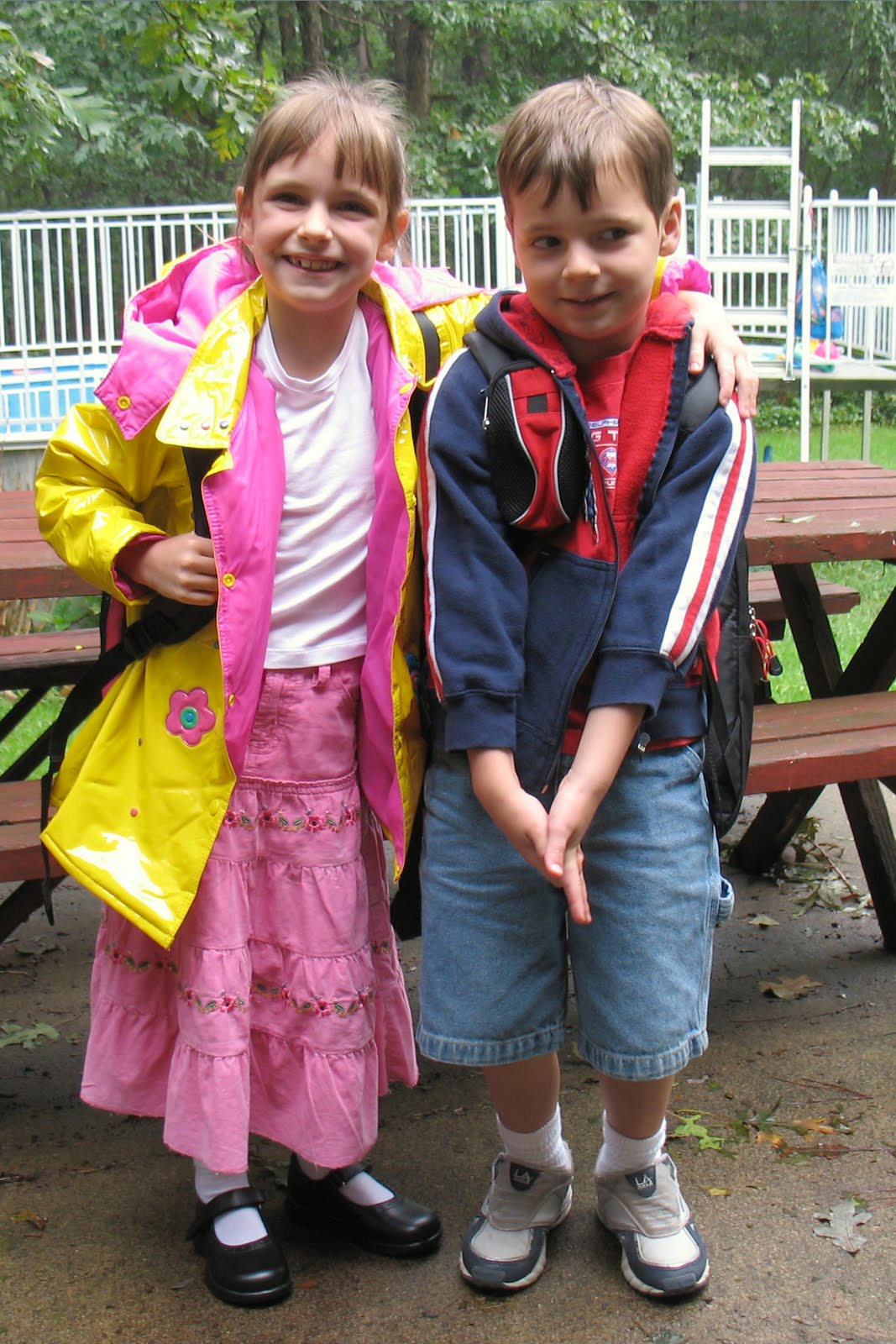
First Day of School!!!!
The kiddos are heading into 7th and 5th grades this year. Whoa. Matthew's last year in elementary school.
Some past First Days, in no particular order:
*sniffle, sniffle*
--End--
Some past First Days, in no particular order:
 |
| 2004 |
 |
| 2006 |
 |
| 2008 |
 |
| 2010 |
 |
| 2003 |
 |
| 2009 |
 |
| 2007 |
--End--
5.16.2011
Braggity-brag-brag-bragging
Sorry, everyone, I am utterly shocked and blown away and cannot resist posting this out there for the world to see.
Phrases my professor used with regard to my work this semester: This is awesome! .... I especially appreciated your overarching argument ....Your writing is particularly noteworthy for how every paragraph advances the central point in a new way .... Similarly, your reading is apt .... stunning and new ... brilliant .... glorious details .... I was really intrigued .... juicy, amazing tidbits .... solid and welcome participation .... pleasure working with you.
In all fairness, please note that this was tempered with: the latter portions lost some inertia--probably the result of time limits or fatigue .... I would have suggested a reorganization of the paper .... the paper needed a firmer thesis .... without adding up to a central argument to take away .... the conclusion was sort of unstable .... The paper made me think a lot, but I'd rather the paper think for me.
Still -- thrilled! A for the course.
--End--
Phrases my professor used with regard to my work this semester: This is awesome! .... I especially appreciated your overarching argument ....Your writing is particularly noteworthy for how every paragraph advances the central point in a new way .... Similarly, your reading is apt .... stunning and new ... brilliant .... glorious details .... I was really intrigued .... juicy, amazing tidbits .... solid and welcome participation .... pleasure working with you.
In all fairness, please note that this was tempered with: the latter portions lost some inertia--probably the result of time limits or fatigue .... I would have suggested a reorganization of the paper .... the paper needed a firmer thesis .... without adding up to a central argument to take away .... the conclusion was sort of unstable .... The paper made me think a lot, but I'd rather the paper think for me.
Still -- thrilled! A for the course.
--End--
Subscribe to:
Posts (Atom)